The event that I attended was the Midwestern Writers on Food. Of course, I had no idea what I was getting into and had no idea what to expect other than the fact that it would have to do with food - obviously. However, I was surprised to find that the event had very little to do with literature at all and mostly had to do with food itself. What was discussed was food and different recipes as well as different ways of cooking things such as fudge or even what to use for the crust of pie (Crisco was agreed to be the best).
There was very little reading done or discussion over the book that the author held in her hand - a book I had never read - and so it was difficult for me, personally, to follow along. I did notice that the audience was mostly composed of elderly ladies who knew so much about how to cook - something I am nowhere near an expert in.
Something that did stick out to me, however, was that these ladies held experiences that were quite admirable. It is unfortunate that our generation was unable to experience the things that they did, the way that they tasted fudge in such a way that we did not. They were able to remember the texture, food making up a major part of their lives, unlike the generation of today where technology reigns. It is unbelievable and sometimes you wish that things would not have changed so much so that you could have beautiful memories the way that they did.
All in all, what I took away from this meeting is not something that had to do with food or literature at all, no. Instead, it made me want to appreciate the simple things that existed, that I would appreciate my childhood and would have something to talk about with such love in the future the way that these ladies talked about food, smiles adorning their features. It was something truly admirable.
Monday, March 31, 2014
Wednesday, March 19, 2014
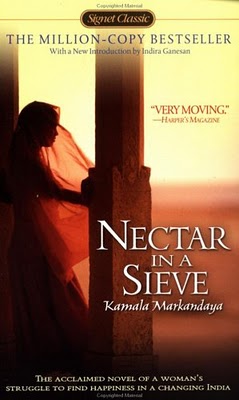
Nectar in a Sieve by Kamala Markandaya - Discovering New Foods
In Kamala Markandaya's story, Nectar in a Sieve, we often come across different foods. However, there is so much that you can barely keep track! Even so, most of the names of the foods were foreign to me and so I decided to take a look at what each of them were. For example, she mentions the food in her garden, "the beans, the brinjals, the chillies and the pumpkin vine."
The first food that I searched up was brinjal since I had never heard it before. However, I realized that it was more familiar than foreign. Brinjal is just another word for eggplant. In South Asia, the plant is referred to as brinjal instead of as eggplant and there are other name variations as well, such as augerbine, garden egg, guinea squash, or melongene. It simply depends on the area that you come from.
The descriptions of food in the text are simply amazing and detailed in such a way that they make you hungry as well. "Between us we prepared mounds of rice, tinting it with saffron and frying it in butter; made hot curries from chillies and dhal; mixed sweet, spicy dishes of jaggery and fruit; broiled fish; roasted nuts over the fire; filled ten gourds with coconut milk; and cut plantain leaves on which to serve the food."
This description is pretty fantastic and some of dishes I was unsure about. I searched up what saffron is and ended up getting the location of an Indian Cuisine restaurant in Kalamazoo called Saffron. However, after looking a bit more, I realized it was a spice commonly known as Saffron Crocus. It is one of the costliest spices by weight and originates in Greece and Southwest Asia. It is said to smell like hay and make foods appear a golden color.
Curry is another dish I was uncertain of. I had heard of it before but never before had I bothered to see what it consisted of. Curries are dishes usually from Southern Asian countries. They consist mainly of spices and herbs or dried chillies, making it somewhat spicy. The spices put into the curry is either whole or ground and the dish can be cooked or raw. Curry can contain meat, poultry, or seafood.
Dhal is something else that was mentioned throughout the book quite a lot. I found that it can also be spelled as Dal and is actually lentils or dried lentils, peas, or beans that have been stripped of their outer hulls and split. Dhal refers to a thick stew so I am imagining that Dhal would be like lentil soup, something that is common to eat in Mexico as well - something I ate when I was younger. I think all of these foods may sound fancy but they are in relation to what we eat everyday as well - unless all you eat is fast food, then that's a different story...
The first food that I searched up was brinjal since I had never heard it before. However, I realized that it was more familiar than foreign. Brinjal is just another word for eggplant. In South Asia, the plant is referred to as brinjal instead of as eggplant and there are other name variations as well, such as augerbine, garden egg, guinea squash, or melongene. It simply depends on the area that you come from.
The descriptions of food in the text are simply amazing and detailed in such a way that they make you hungry as well. "Between us we prepared mounds of rice, tinting it with saffron and frying it in butter; made hot curries from chillies and dhal; mixed sweet, spicy dishes of jaggery and fruit; broiled fish; roasted nuts over the fire; filled ten gourds with coconut milk; and cut plantain leaves on which to serve the food."
This description is pretty fantastic and some of dishes I was unsure about. I searched up what saffron is and ended up getting the location of an Indian Cuisine restaurant in Kalamazoo called Saffron. However, after looking a bit more, I realized it was a spice commonly known as Saffron Crocus. It is one of the costliest spices by weight and originates in Greece and Southwest Asia. It is said to smell like hay and make foods appear a golden color.
Curry is another dish I was uncertain of. I had heard of it before but never before had I bothered to see what it consisted of. Curries are dishes usually from Southern Asian countries. They consist mainly of spices and herbs or dried chillies, making it somewhat spicy. The spices put into the curry is either whole or ground and the dish can be cooked or raw. Curry can contain meat, poultry, or seafood.
Dhal is something else that was mentioned throughout the book quite a lot. I found that it can also be spelled as Dal and is actually lentils or dried lentils, peas, or beans that have been stripped of their outer hulls and split. Dhal refers to a thick stew so I am imagining that Dhal would be like lentil soup, something that is common to eat in Mexico as well - something I ate when I was younger. I think all of these foods may sound fancy but they are in relation to what we eat everyday as well - unless all you eat is fast food, then that's a different story...
Sunday, March 16, 2014
Nectar in a Sieve by Kamala Markandaya (Page 1 - 50)
The story that I chose is called Nectar in a Sieve, written by Kamala Markandaya. I was not completely interested in the book at first, but once I started reading it, it became more and more interesting to me. I really enjoyed the way in which the story was written, from the character's point of view. It was also extremely descriptive and it kept my attention while I was reading.
The story is told from our main character's point of view - Ruku, which is Rukmani for short. She is telling her story from the present so she gives us a look at her past which seems pretty sweet in comparison to the bitter present. Her husband is already dead and so it is quite sad how she starts off, telling of how she can feel her husband still with her beside her. I think it would be very sad to experience something like this. I don't think I would be able to live without my husband after having spent so much time with him.
The rest of the first fifty pages starts telling the story of how they got married, their marriage starting off when Ruku was only 12 years old. She mentions how she was married beneath her, to a poor farmer because she had little money and no dowry to offer. It was also said that she was scared of her new life. However, throughout the story, her husband seemed very loving and nice to her, always being sure to take care of her. He had made their house himself and he comforted her when she needed it. Although she was very inexperienced nor did she have the looks apparently, he never put her down and he treated her well.
She also made a few friends from the village who would talk to her and tell her things, which is how she found out about her husband having made their house. Even later, she has to help her friend deliver her child although the girl - whose name I cannot remember (many of the names are difficult to remember) - did not want her to be present for her childbirth. Ruku learns very much and her husband even comments that she had grown into a woman after only the first month, having learned many things and even how to grow things. One of the things I thought was cute was when she grew a pumpkin and she was very proud of it, much like a child would be, although she is of course a child.
The story is told from our main character's point of view - Ruku, which is Rukmani for short. She is telling her story from the present so she gives us a look at her past which seems pretty sweet in comparison to the bitter present. Her husband is already dead and so it is quite sad how she starts off, telling of how she can feel her husband still with her beside her. I think it would be very sad to experience something like this. I don't think I would be able to live without my husband after having spent so much time with him.
The rest of the first fifty pages starts telling the story of how they got married, their marriage starting off when Ruku was only 12 years old. She mentions how she was married beneath her, to a poor farmer because she had little money and no dowry to offer. It was also said that she was scared of her new life. However, throughout the story, her husband seemed very loving and nice to her, always being sure to take care of her. He had made their house himself and he comforted her when she needed it. Although she was very inexperienced nor did she have the looks apparently, he never put her down and he treated her well.
She also made a few friends from the village who would talk to her and tell her things, which is how she found out about her husband having made their house. Even later, she has to help her friend deliver her child although the girl - whose name I cannot remember (many of the names are difficult to remember) - did not want her to be present for her childbirth. Ruku learns very much and her husband even comments that she had grown into a woman after only the first month, having learned many things and even how to grow things. One of the things I thought was cute was when she grew a pumpkin and she was very proud of it, much like a child would be, although she is of course a child.
Friday, February 28, 2014
Hunger Games Ch. 6 - 18

For this part of the book, I was definitely anxious to get straight to the action. My favorite parts of the book are in the last third of it. However, in this section we get to see how they train and a small peak of what may happen in the future. Peeta and Katniss both have to show their skills when training and we can see that they both have some survival skills - things that will come in handy once they get into the real games. One of the biggest parts, however, is the part where they get their scores for showing the Gamemakers their skills. Because of Katniss's spunk and attitude, she earns herself a higher score than the rest while Peeta is left with a smaller score, surprising everyone. However, this will make her the prey of the rest of the competitors since taking down the best is the best method to keep from being killed by them.
Another part that we get to see is when they get their interviews and Peeta spills out his feelings for Katniss. Now for this part, I saw it coming from the moment Peeta was introduced in the book since a cliché love story is always there for teen literature. I personally don't like the idea of just sprinkling in a romance story when it could be focusing more on the seriousness of the games. And of course we get this sort of conflicted Katniss since she claims not to love Peeta and thinks herself self-sufficient, but obviously she will fall for him at some point. At one part she even says, "For some reason Gale and Peeta do not coexist well together in my thoughts." So, we can already see what may come in the future - or what I'm guessing at least.
Once the games start, it's all killing and survival and basically the weaker, not-too-important-characters are killed off. The only parts that I favor at this point are the moments between Katniss and the little girl named Rue since I find it endearing. What's funny though is that Katniss neglected to trust Peeta when he was being nice because she claimed that he was only trying to think of ways to kill her while with Rue she easily gave in and treated her like part of her family. The relationship between them is similar to her relationship with her own sister, making it an important one since Prim is Katniss's weakness. The fact that Rue dies in the end is rather unfortunate and probably the best part of the book since it was realistic in a way and touching to see that Katniss still put flowers all around her to honor her.
After this we are left at the beginning of part three where the victor is to be decided. However, this time Katniss is to team up with Peeta to win.
Wednesday, February 26, 2014
Hunger Games Ch. 1 - 5
I had already read the Hunger Games before back in high school so it felt like a nice break to be able to relax and read something that actually captured my attention.
The first five chapters had to do mostly with the Reaping, the event held each year to choose one girl and one boy from each district to compete in what they called the Hunger Games. In these games they would kill each other until there was only one winner left and that person would be the only one who could return home to their district.
Our main character is Katniss and she ends up volunteering for her sister Prim who was selected to be one of the fighters for their district. We can easily see that Katniss is extremely protective of her sister and will do anything to make sure that she is safe and sound. Katniss has a weak spot and that only weak spot is Prim so she sacrifices herself to save her little sister and enlists herself in the games instead. I can see why people would like this book since that relationship is pretty idealistic and humane. We don't usually see people sacrificing themselves for each other these days and to be honest, that part is very sad to me. It is sad to see that the family will be possibly torn apart. I know that personally I could never withstand something like that. I would not want to see my family hurt like that and especially since Katniss and her family had already lost their father.
In the end, I feel like reading this a second time will actually be quite enjoyable since I love the plot. The only thing I don't quite enjoy is how predictable it is despite the suspense thy try to put into the story.
Sunday, February 23, 2014
A Family Forced Apart
I had only ever heard about the book The Jungle by Upton Sinclair, but never thought much of it. However, after reading through the assigned chapters, fourteen through twenty, I was extremely shocked, but not only that. I was extremely depressed. I could not imagine the feelings that Jurgis had to go through while he attempted to protect his family. It felt so unjust to see how his wife had basically been forced into having sex with her boss over and over again for months. It was sad because it reminded me of the story by Rigoberta Menchu Tum where she mentioned that her friend was asked to become the boss's mistress and when she refused, she was quickly "taken care of."
It was so unjust as well to see how Jurgis was taken out of his job and punished by being sent to jail while Connor - Ona's boss - was able to carry on as though nothing happened. I actually felt hatred for Connor after the fact that he raped Ona but even more so after he was ruining Jurgis and his family's life by keeping them out of jobs. I only then understood the meaning of the title since it really was a jungle that they were living in. Everyone was acting like animals but more like predators, looking for things to devour for their own personal gain.
I initially was expecting to see more of the struggles at the meat industry, but I was drawn more to the portion about Jurgis and his family. It was upsetting to see how the immigrants were treated after they came in search for something more, something better than what they had before. However, as we can easily see, they only got worse. I was especially upset after seeing that Ona died after giving birth, the baby dying as well. I can understand why Jurgis would drink then but I was still thinking that he probably should have saved the few dollars that were made from working instead of spending them on liquor...
It was so unjust as well to see how Jurgis was taken out of his job and punished by being sent to jail while Connor - Ona's boss - was able to carry on as though nothing happened. I actually felt hatred for Connor after the fact that he raped Ona but even more so after he was ruining Jurgis and his family's life by keeping them out of jobs. I only then understood the meaning of the title since it really was a jungle that they were living in. Everyone was acting like animals but more like predators, looking for things to devour for their own personal gain.
I initially was expecting to see more of the struggles at the meat industry, but I was drawn more to the portion about Jurgis and his family. It was upsetting to see how the immigrants were treated after they came in search for something more, something better than what they had before. However, as we can easily see, they only got worse. I was especially upset after seeing that Ona died after giving birth, the baby dying as well. I can understand why Jurgis would drink then but I was still thinking that he probably should have saved the few dollars that were made from working instead of spending them on liquor...
Wednesday, February 19, 2014
Bad Treatment & Disgusting Conditions...
The part about the immigrants, however, did not get the best of me. It was only the third chapter and we already see that things are getting disgusting by the way Jurgis has to deal with the meat packing industry at work. There were sanitation rules but they were not being followed at all and I was grossed out by the fact that several of the animals were not getting checked properly and were allowed to pass on to the next stage even if they could have had tuberculosis. What is even more disgusting is the fact that the spoiled meat was still packed in with the other meat.
I know just from this that I would not want to eat any of this meat at all and it would be gross to have to do so in the old days... I'm glad that Sinclair helped bring everyone's attention to the meat industry and that it is supposedly a lot better now. If it weren't, I might as well become a vegetarian or something of that sort...
Subscribe to:
Posts (Atom)